
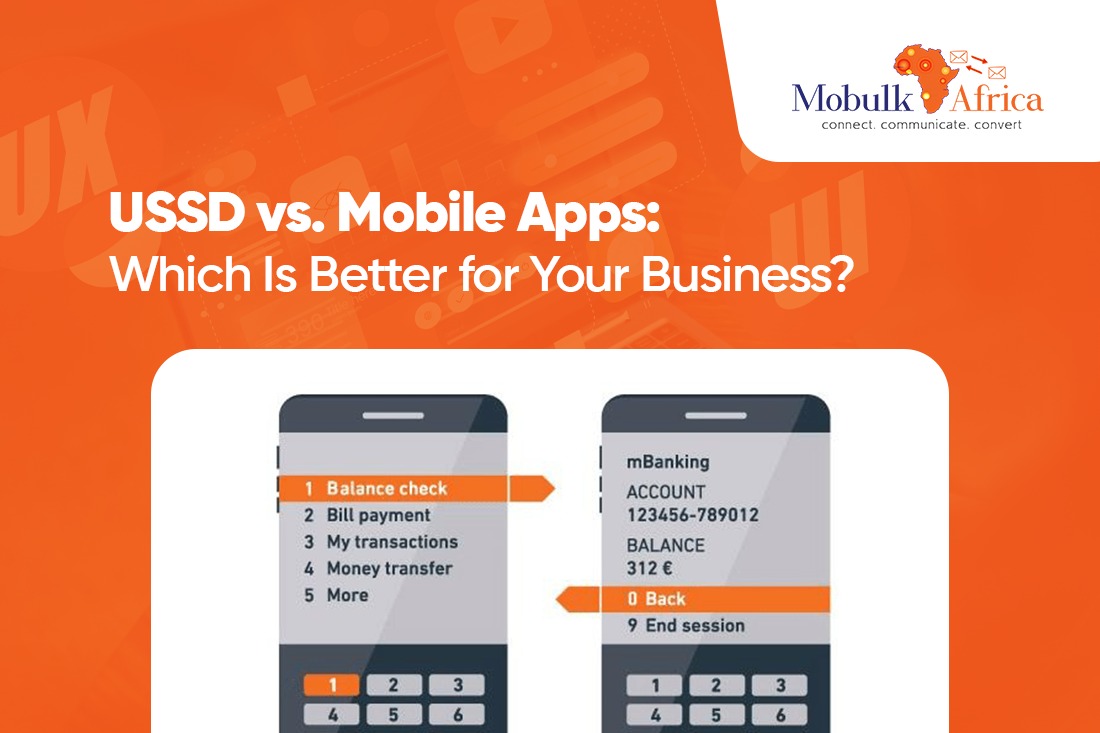
As mobile technology continues to evolve across Africa, businesses face a critical decision: should they invest in Unstructured Supplementary Service Data (USSD) or a mobile application to reach their customers? Both platforms have unique advantages, but their effectiveness depends on factors like your target audience, industry, and service goals.
At Mobulk Africa, we’ve helped hundreds of African businesses navigate this decision, particularly in markets like Kenya, Nigeria, Ghana, and South Africa. This guide presents a factual, comparative analysis of USSD and mobile apps to help you make the most strategic choice.
What Is USSD?
USSD (Unstructured Supplementary Service Data) is a communication protocol used by GSM cellular telephones to communicate with the mobile network operator. It allows users to interact with a system through short codes (e.g., *123#) without needing mobile data or internet.
USSD sessions are real-time and highly responsive, making them ideal for:
- Mobile banking
- Airtime purchases
- Service registration
- Account balance checks
Usage Fact: According to GSMA, over 60% of mobile financial transactions in Sub-Saharan Africa in 2023 were conducted via USSD.
What Are Mobile Apps?
Mobile applications are software programs developed specifically for smartphones and tablets. Apps are installed via app stores like Google Play or Apple App Store and rely on mobile data or Wi-Fi for functionality.
They can offer advanced features such as:
- Rich user interfaces
- Push notifications
- In-app payments
- Offline storage (in some cases)
- Integrated analytics and user tracking
Stat: As of 2024, there were over 50 million smartphone users in Nigeria alone, and this number is expected to rise steadily across the continent.
Key Comparison: USSD vs. Mobile Apps
| Feature | USSD | Mobile Apps |
|---|---|---|
| Internet Required | No | Yes |
| Device Compatibility | All GSM phones | Smartphones only |
| User Experience | Basic (text-based) | Advanced (graphical, interactive) |
| Cost to User | Often free | Data charges apply |
| Development Time | Faster | More complex |
| Security | Secure with session timeouts | High security with encryption |
| Update Flexibility | Changes done on server-side | Requires app updates/downloads |
| Accessibility | Rural and urban users | Urban and smartphone users only |
When USSD Is the Better Choice
1. Targeting Low-Income or Rural Audiences
In many African regions, a significant percentage of the population still uses feature phones. For instance, the Communications Authority of Kenya reported in 2024 that only 56% of mobile users had smartphones. That means a large user base is unreachable via mobile apps.
USSD works perfectly here. It doesn’t require smartphones or data, just a GSM connection.
Real Example: M-Pesa, Kenya’s mobile money leader, began with USSD (*234#) and still relies heavily on it to reach users without smartphones.
2. Banking and Financial Services
USSD provides fast, secure, and reliable transactions. Banks like GTBank (Nigeria) and Equity Bank (Kenya) still prioritize USSD for basic account services.
Why? Because it allows:
- Balance checks
- Fund transfers
- Airtime top-ups
- Loan applications
without internet dependence.
3. Mass Service Delivery
For government services, polling, utility payments, or NGO campaigns, USSD is the ideal tool for mass, low-cost, and wide-reaching engagement.
When Mobile Apps Make More Sense
1. Enhancing User Experience
If your business requires:
- Graphical content
- Navigation menus
- Location-based services
- Multimedia (images/videos)
then a mobile app is a better fit.
Example: E-commerce platforms like Jumia and Takealot use apps to allow users to browse products, track deliveries, and pay online.
2. Targeting High-Income, Urban, or Younger Demographics
Young professionals in Nairobi, Lagos, Johannesburg, and Accra are more likely to own smartphones and expect modern digital experiences. For these users, apps offer convenience and branding.
Fact: A GeoPoll survey in 2023 found that 78% of smartphone users aged 18–35 in urban Africa prefer using apps for purchases and bookings.
3. In-App Analytics and Retention Tools
Apps allow you to collect more user data for optimization:
- Time spent per page
- Feature usage patterns
- Cart abandonment rates
They also support:
- Push notifications
- In-app surveys
- Personalized content delivery
This helps in refining product offerings and increasing customer retention.
Considerations for Cost and Development
| Factor | USSD | Mobile App |
| Initial Setup Cost | $200 – $1,000 (basic) | $3,000 – $20,000+ |
| Monthly Hosting | Low | Depends on cloud infrastructure |
| Maintenance | Easy (server-side updates) | Requires user updates and testing |
| Time to Launch | 2–4 weeks | 6–16 weeks |
At Mobulk Africa, we offer affordable USSD and app development packages tailored for African SMEs and large enterprises alike.
Which One Is More Secure?
Security depends on implementation. Both USSD and apps can be secure if best practices are followed.
- USSD: Secured via session-based communication and PINs. Vulnerable if handset is lost.
- Apps: Secure if encrypted and regularly updated. Can be enhanced with biometrics, 2FA, and SSL.
Conclusion: Apps provide more advanced security, but USSD is still safe for basic transactions if designed correctly.
Integration and Flexibility
USSD systems are tightly integrated with telco networks and are harder to scale with third-party integrations. Apps, on the other hand, easily integrate with:
- Payment gateways
- CRM systems
- Push notification APIs
- Analytics platforms
This makes apps ideal for businesses looking to scale their digital ecosystem.
Hybrid Strategy: Why Not Both?
Some businesses combine both platforms to serve different user segments. For example:
- USSD serves rural customers for registration and payments.
- Mobile App serves urban customers with advanced features.
Case Study: A microfinance company in Uganda used USSD for loan applications and an app for loan tracking and educational content. The result? A 2x increase in user engagement and 40% drop in support queries.
Which Is Better?
There is no one-size-fits-all answer. The decision depends on your business type, customer base, and service goals.
| Business Type | Recommended Option |
| Banks & Fintech | USSD + App |
| E-commerce | App |
| Government Services | USSD |
| NGOs/Donor-Funded Projects | USSD |
| Urban-based Startups | App |
| Nationwide SMEs | USSD initially, app later |
Work With Mobulk Africa
Mobulk Africa helps businesses across the continent develop both USSD and mobile app solutions that are:
- Affordable
- Secure
- Scalable
- Telco-integrated
Whether you need to reach remote farmers in Eldoret or tech-savvy students in Cape Town, we tailor the right mobile technology for you.
Get in touch today: Call/WhatsApp : 0795435940 | Email : dm@mobulkafrica.pro
Leave a Reply